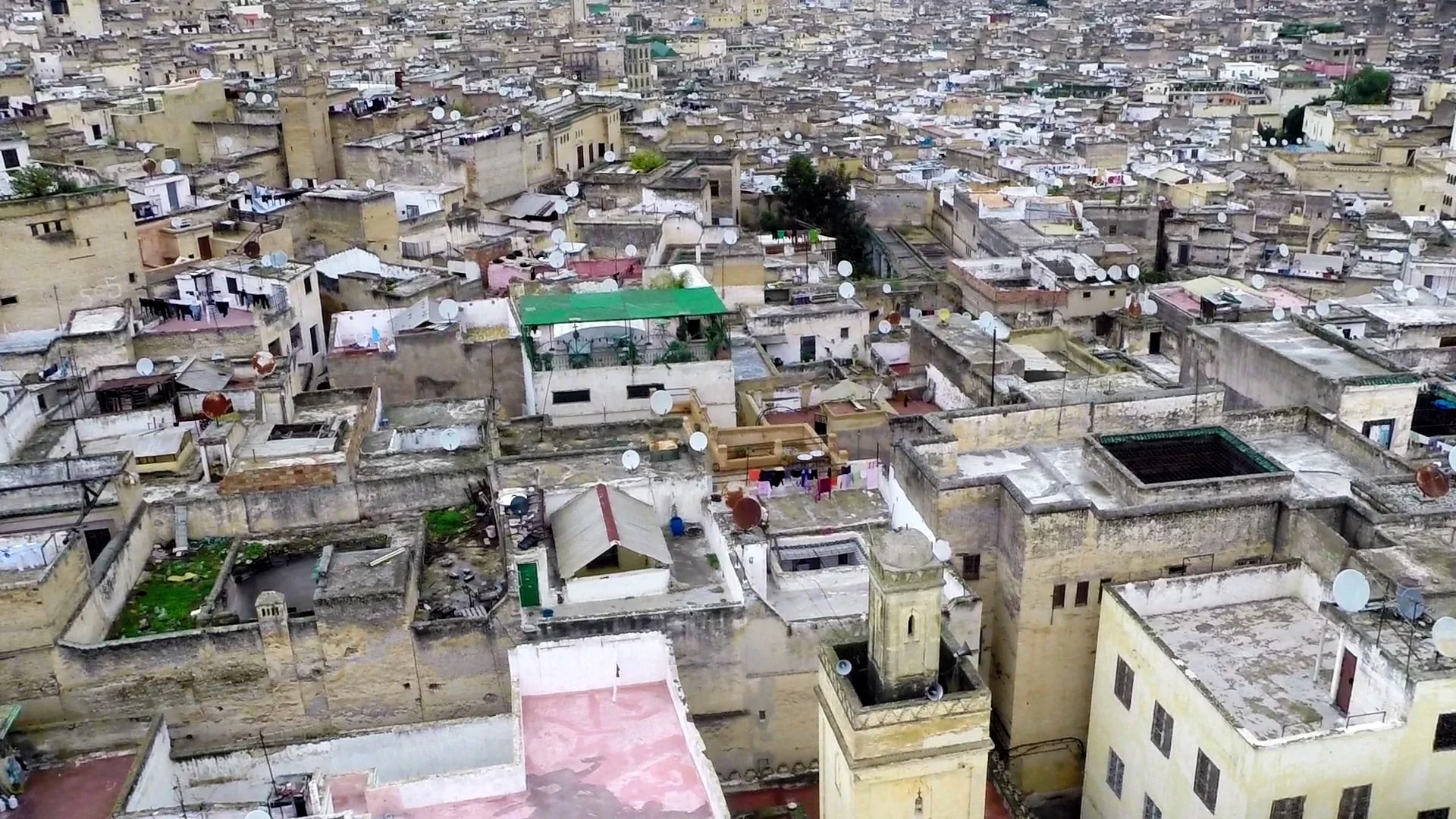
 A dense urban area with flat-roofed, beige buildings tightly packed together, some satellite dishes and laundry visible on rooftops, stretching into the distance.
Fez
Morrocco
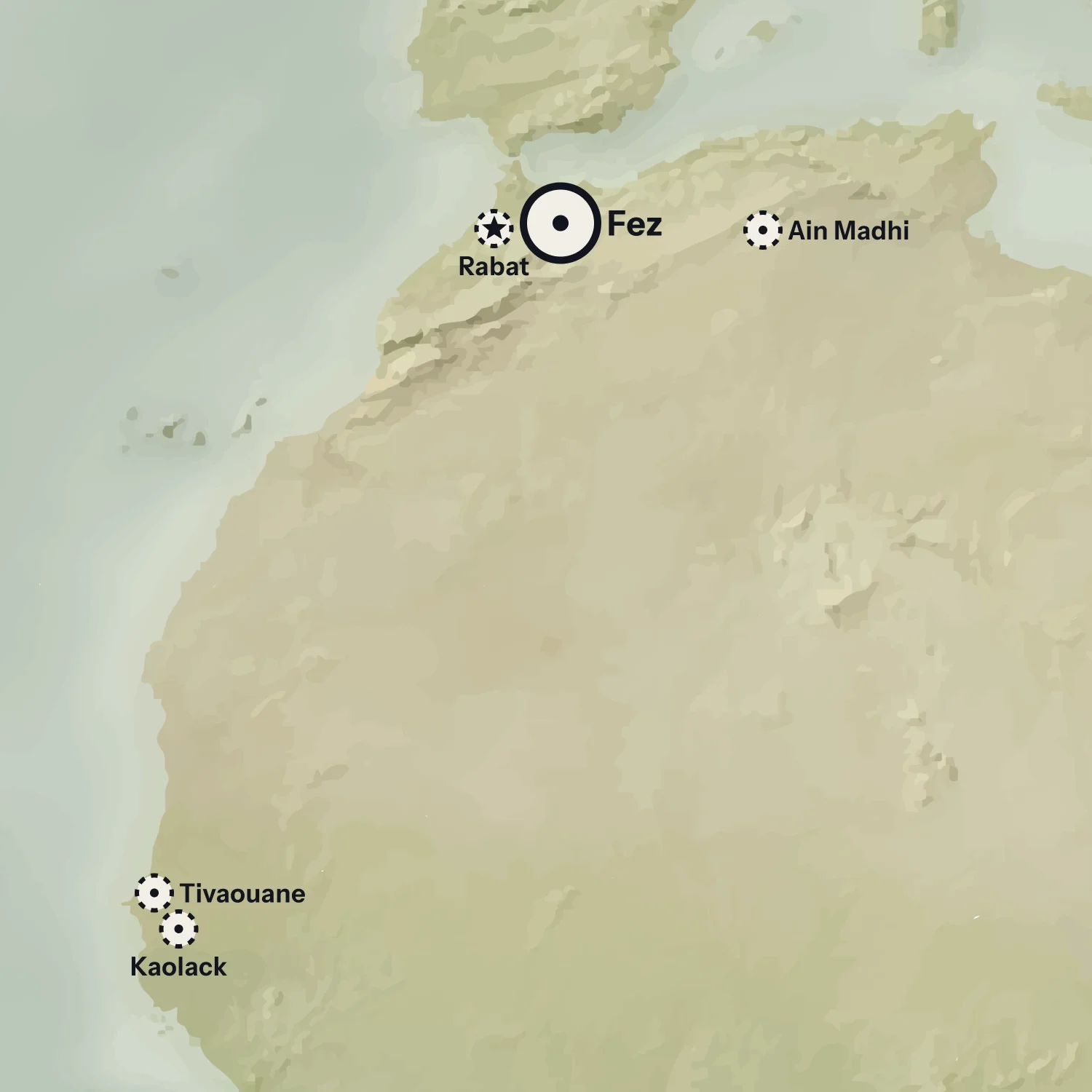
At the crossroads of West and sub-Saharan Africa, Europe, and the Mediterranean, its strategic position made the city of Fez in Morocco an important commercial and intellectual hub. Founded in the late eighth century by Moulay Idris I (r. 788–791) and developed by his son Moulay Idris II (r. 803–828), it quickly became one of the major urban centers of North Africa. Architectural and artistic patronage accompanied the economic prosperity of the city under the Almoravids (1054–1147) and the Marinids (1215–1465).
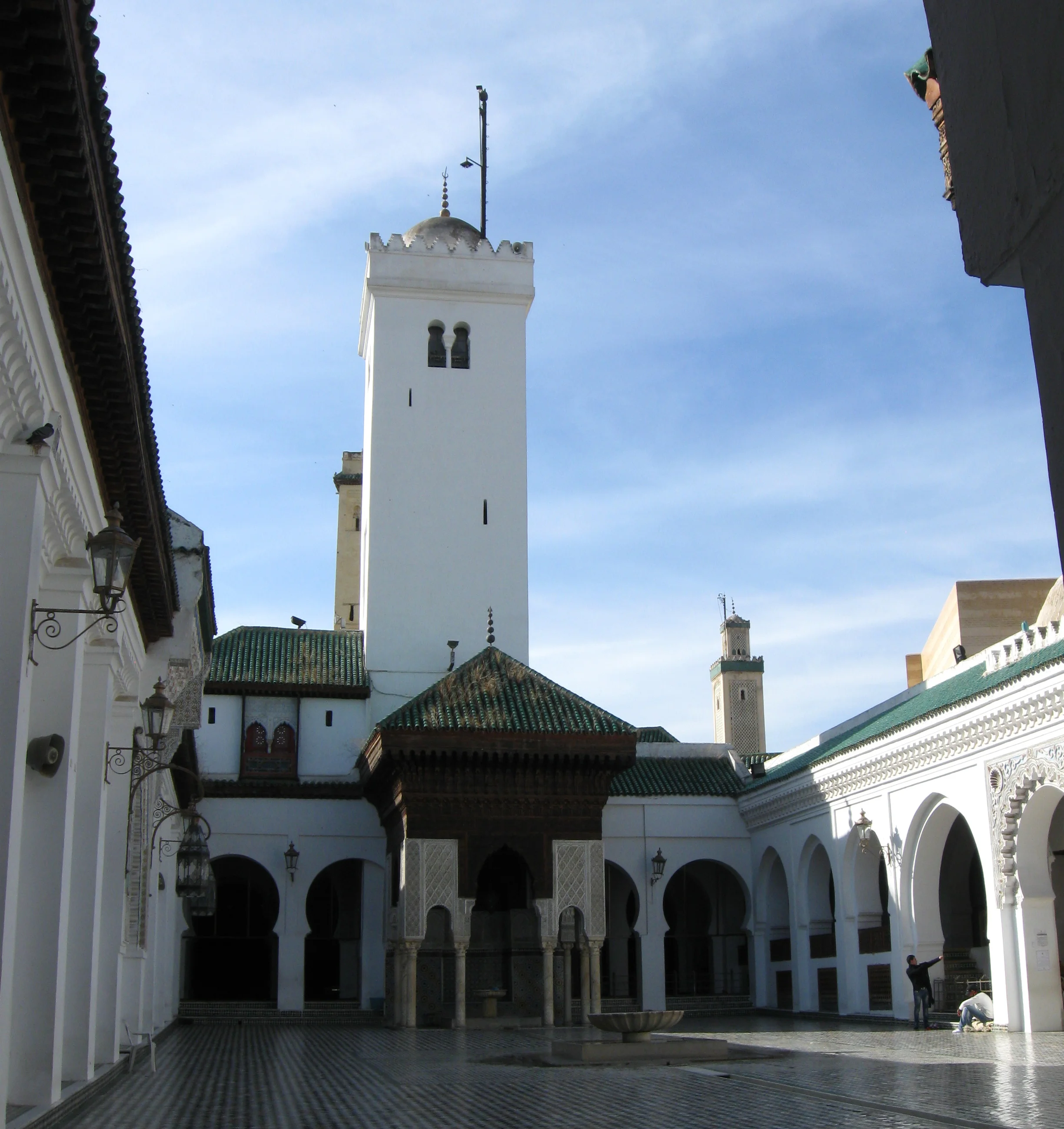
In the mid-tenth century, Fatima al-Fihri, a wealthy woman from Tunisia, founded the University of al-Qarawiyyin. The oldest university with uninterrupted activity in the world, al-Qarawiyyin attracted scholars and students from other parts of the Islamic world, contributing to the reputation of Fez as a city of knowledge. Many famous figures studied here including the great poet, mystic, and philosopher Ibn Arabi (1165–1240), who came from Al-Andalus in the Iberian Peninsula.
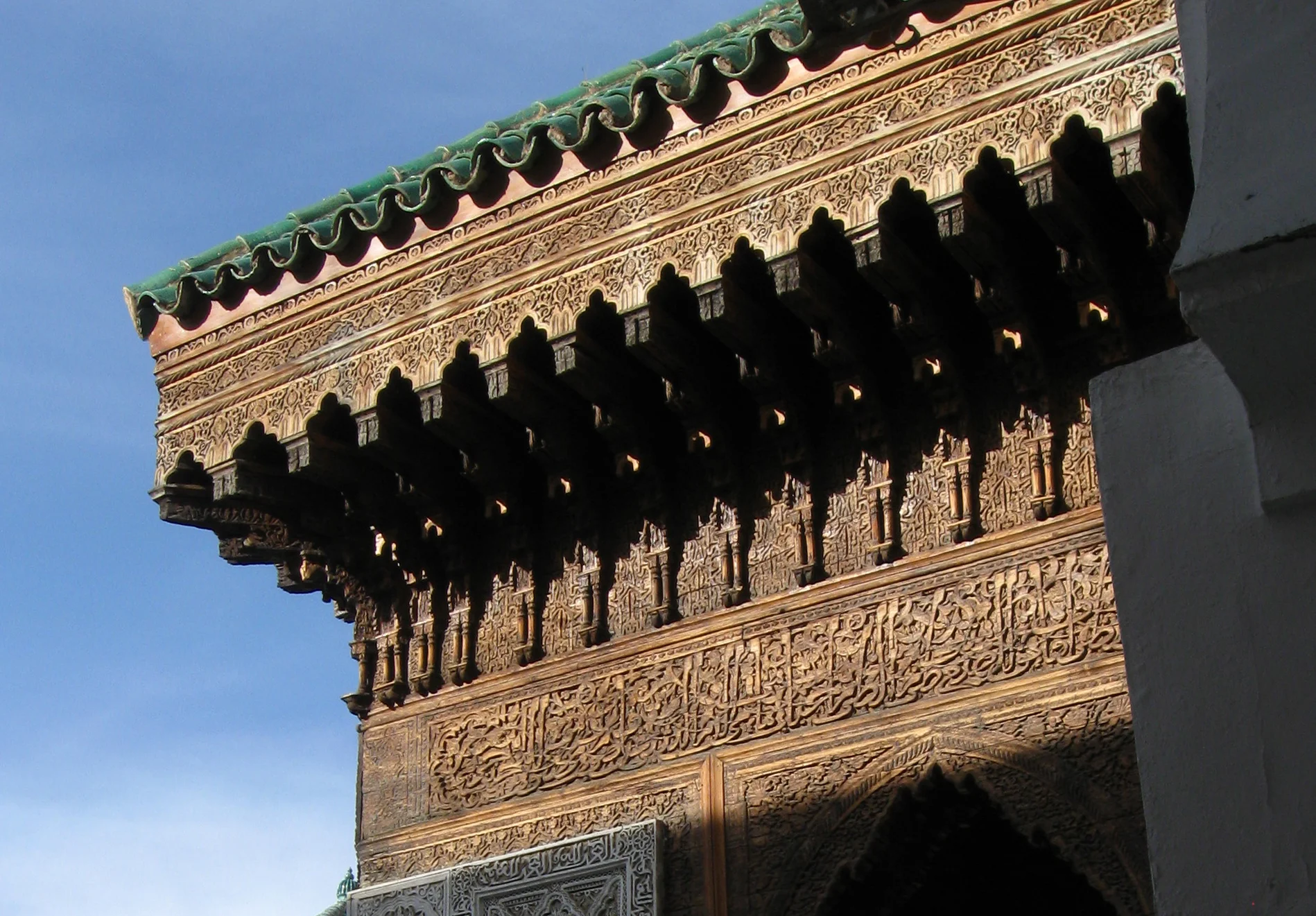
Courtesy of Eric Ross.
Fez also became a renowned center for Sufism. Sufi shaykh and writer Muhammad b. Sulayman al-Jazuli (d. 1465) lived there before establishing his tariqa, a branch of the Shadhiliyya in the coastal city of Safi. He composed his famed Dala’il al-khayrat (Waymarks of Benefits), a collection of prayers on the Prophet Muhammad, one of the most popular prayer books in the Islamic world. After the Qur’an, it was also one of the most frequently copied works and often lavishly illuminated in Morocco before 1900.
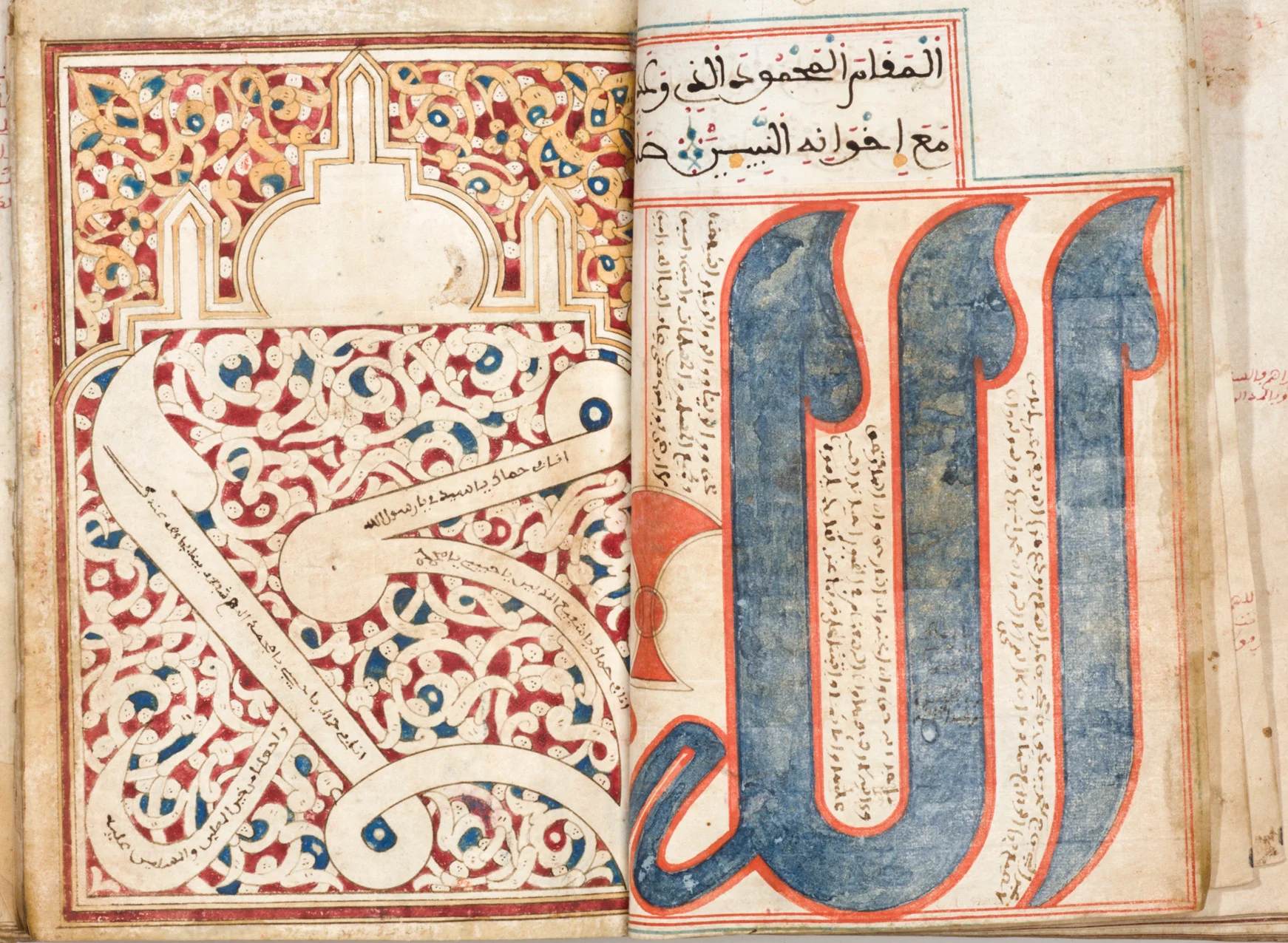
Hajj and the Arts of Pilgrimage, Khalili Collections. Courtesy of the Khalili Family Trust.
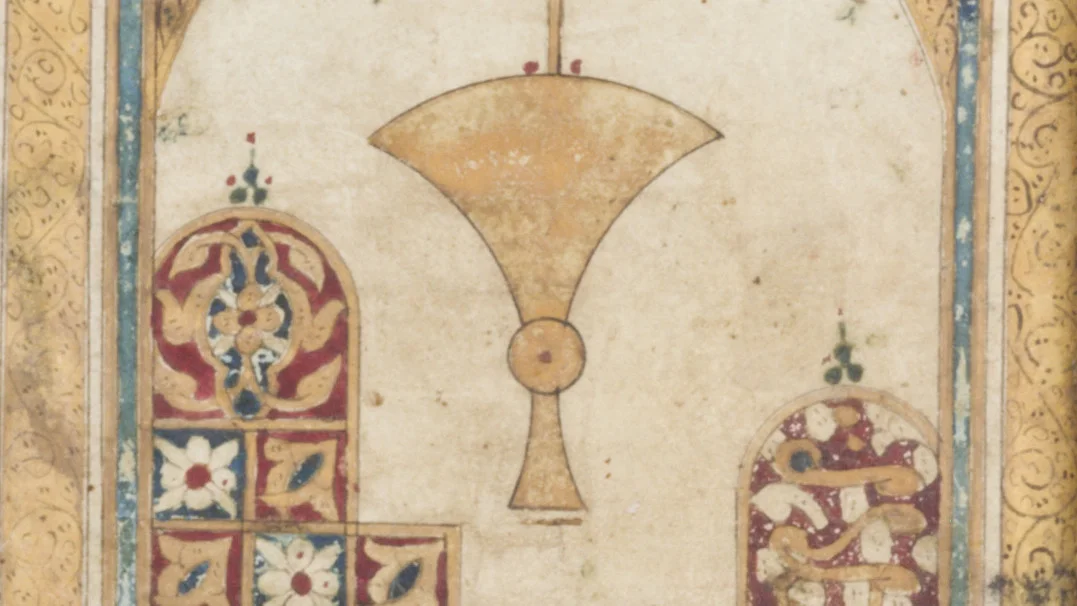
Additionally, the Dala’il al-khayrat has the particularity to be a religious work decorated with illustrations. They consist of stylized representations of the funerary chamber of the Prophet Muhammad with the tombs of his successors Abu Bakr and Umar ibn al-Khattab in the Prophet’s Mosque in Medina as well as of the mihrab and minbar. After the seventeenth century, other images were introduced, such as the depiction of the sandals of the Prophet and of the sanctuary in Mecca.
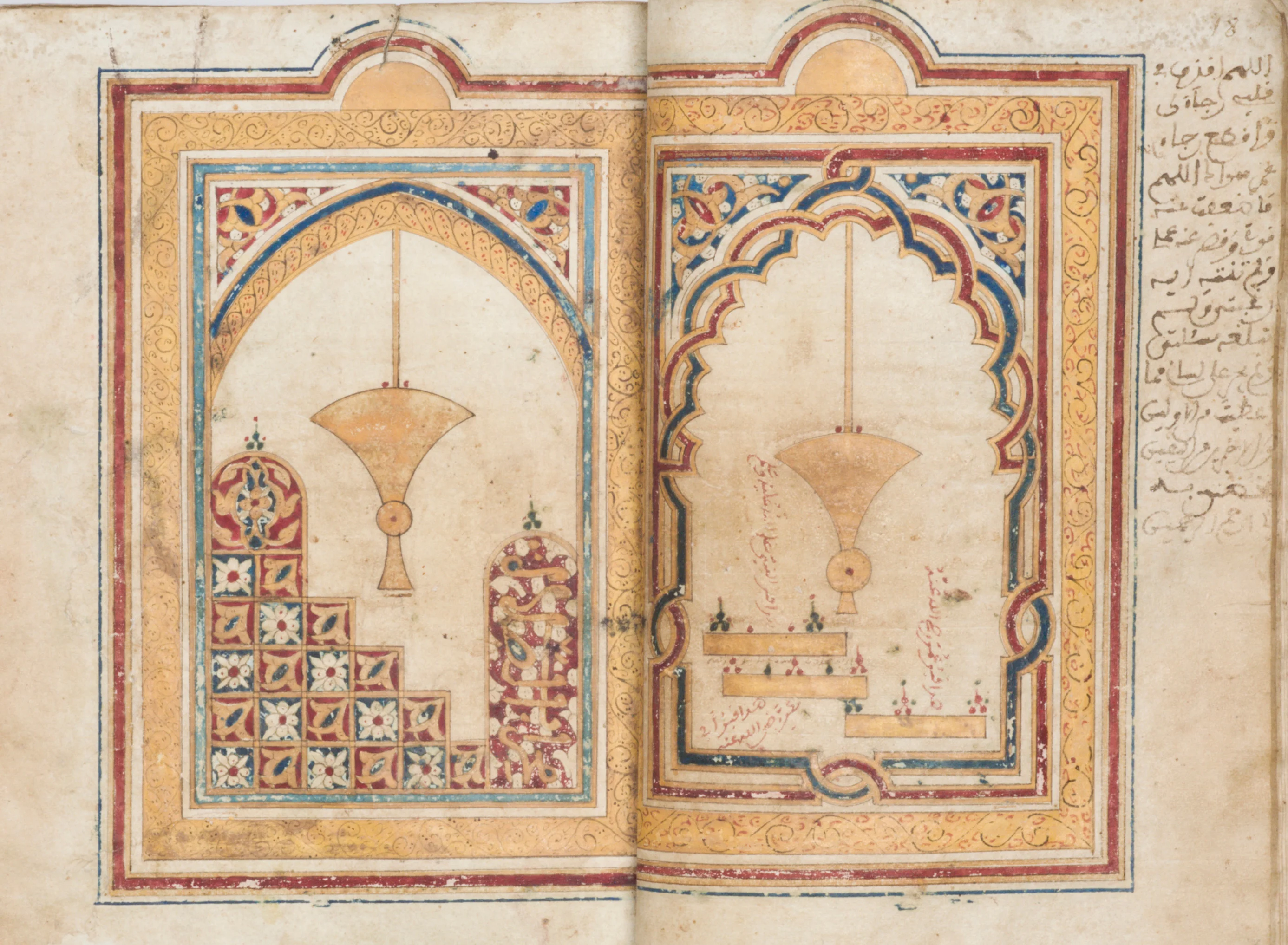
Hajj and the Arts of Pilgrimage, Khalili Collections. Courtesy of the Khalili Family Trust.
© Leonard de Selva / Bridgeman Images.
Shaykh Ahmad al-Tijani and his Tariqa
Among the Sufi masters who lived in Fez was Shaykh Abu’l-Abbas Ahmad al-Tijani (1737–1815). Born in Aïn Madhi in the south of Algeria, he studied at al-Qarawiyyin in Fez and was initiated into several tariqas, including the Shadhiliyya. Thereafter, al-Tijani lived many years in Tunisia, Egypt, and Arabia before returning to Morocco. Reportedly, he had a waking vision of the Prophet Muhammad asking him to establish a new brotherhood, whose mystical theology was inspired by great scholar, mystic, and philosopher Ibn Arabi (d. 1240). Like many Sufi orders, it was named after its founder: the Tijaniyya.
Al-Tijani eventually settled in Fez and his tariqa quickly gained followers throughout the Maghrib. He departed significantly from other Sufi orders by proclaiming that he was the seal of sainthood just as the Prophet Muhammad was the seal of prophethood. More than in any other tariqas, certain rules have to be followed, including the strict prohibition against visiting tombs of Islamic holy figures and saints, except the Prophet’s at Medina. Adherents are also not allowed to be committed to multiple Sufi orders.
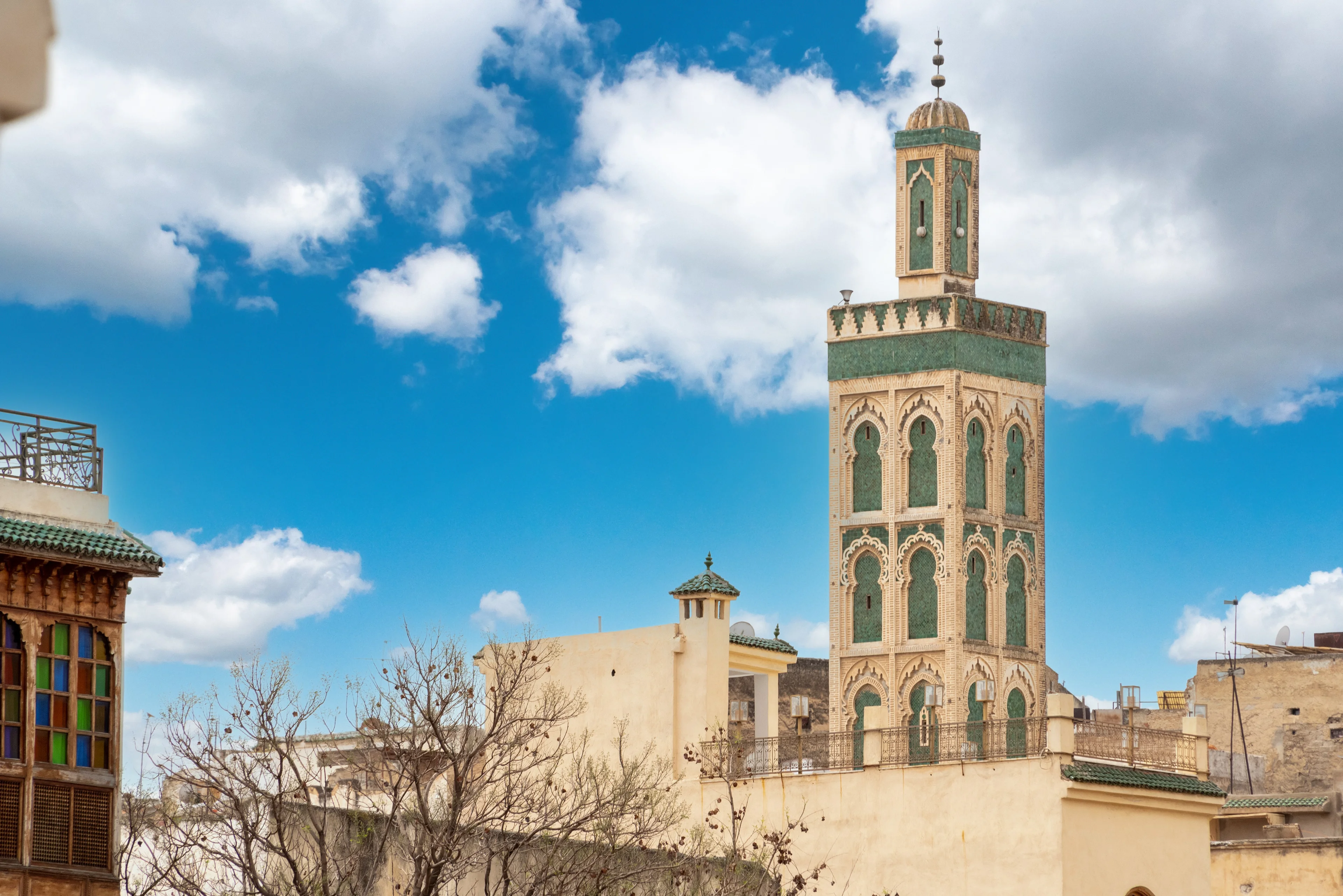
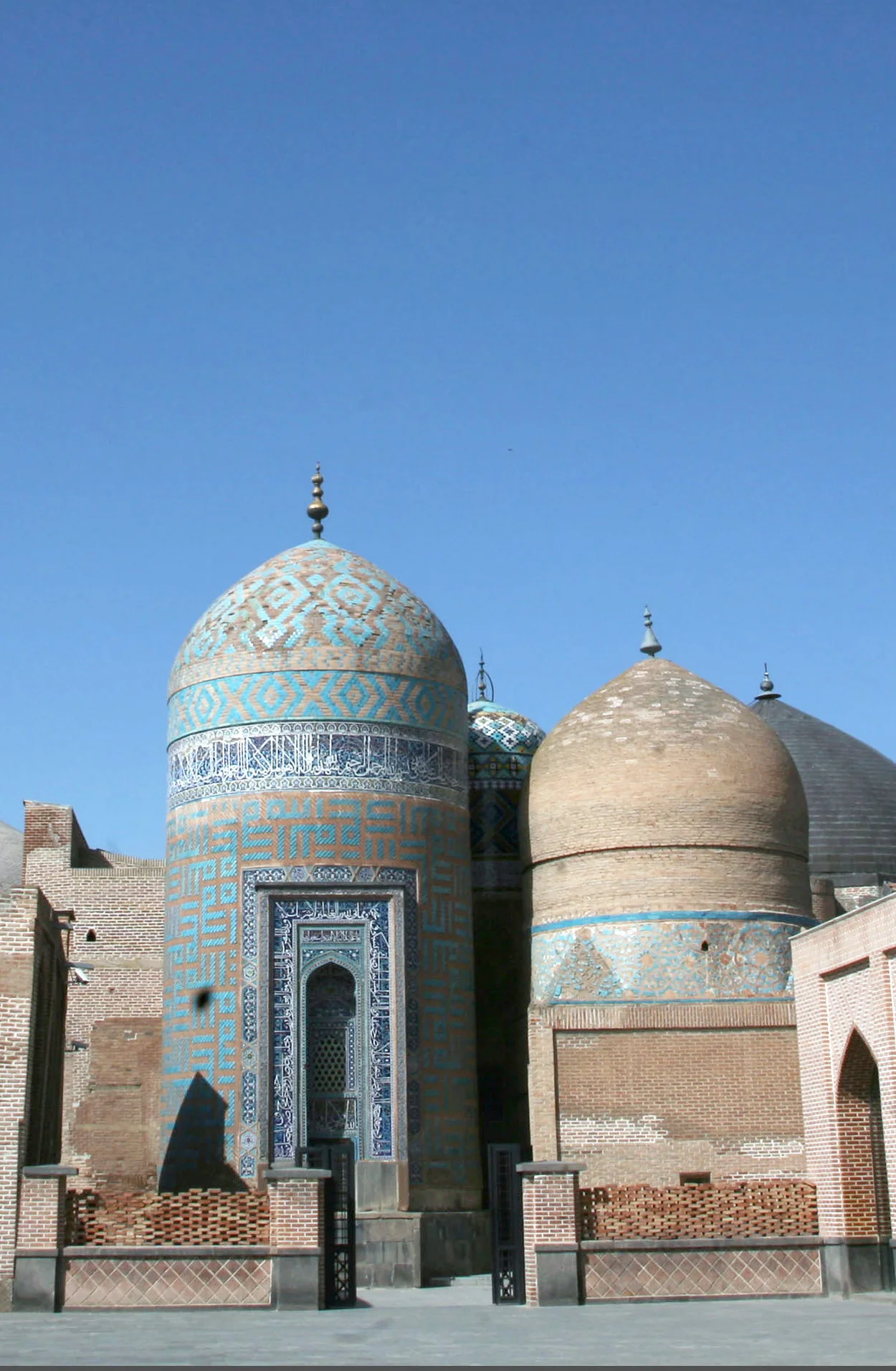
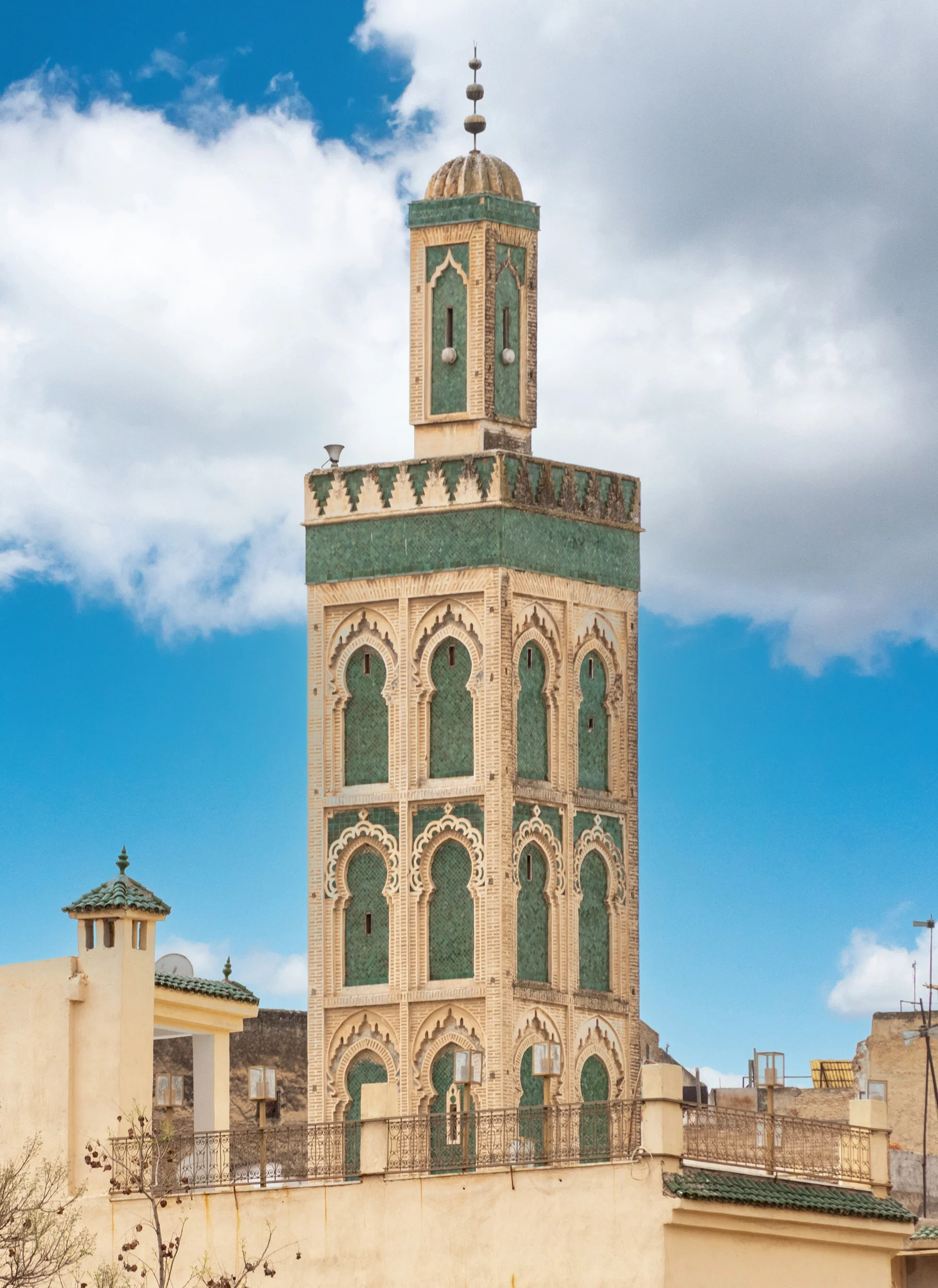
The tomb of Shaykh Ahmad al-Tijani is located in the heart of his zawiya in Fez. Nested in the old city near al-Qarawiyyin, the building is richly decorated both inside and outside, with its unique minaret covered with turquoise tiles. It not only showcases the wealth of the Tijaniyya but also confirms the support of royal patronage as the Moroccan Sultan Moulay Sulayman (d. 1822) sponsored the zawiya’s construction.
A tour of the zawiya of Shaykh Ahmad al-Tijani
Courtesy of Secrets of Fes
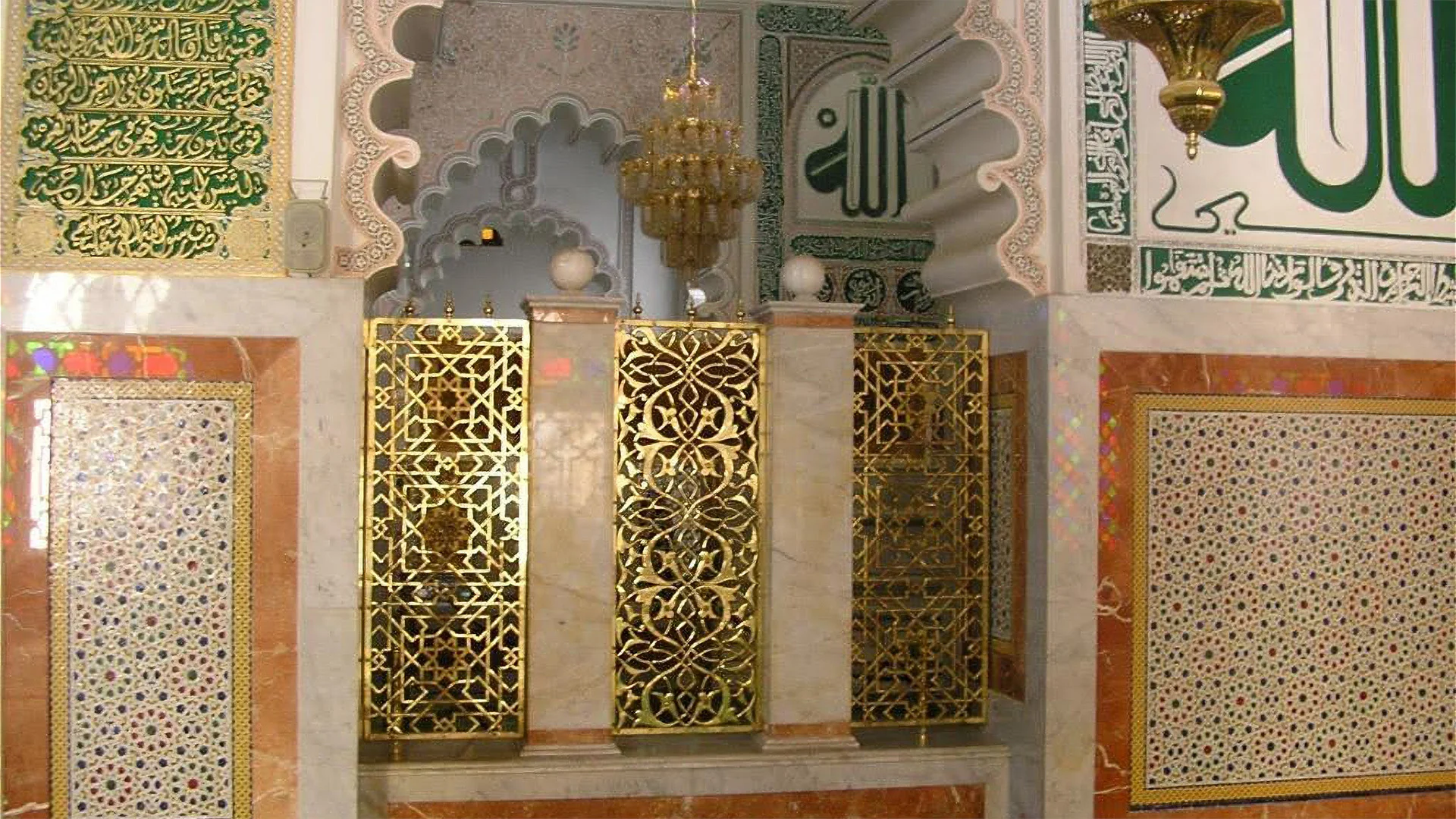
Among the responsibilities of the members of the tariqa is following the leadership of the shaykh of their branch. They also show a deep respect for the Tijani silsila back to the order’s founder, Shaykh Ahmad al-Tijani. Like other Sufi brotherhoods, the practice of dhikr is central, but the Tijaniyya also has specific wird. For instance, the prayer upon the Prophet Muhammad called the Salat al-fatih (Prayer of the Opener) occupies a special place in Tijani practices. It is recited individually or in groups.
It reads:
O Allah, send prayers upon our master Muhammad, the opener of what was closed, and the seal of what had preceded, the helper of the truth by the Truth, and the guide to Your straight path. May Allah send prayers upon his Family according to his greatness and magnificent rank.
Prayer of the Opener
Transmitted by Muhammad ibn Abi’l-Hasan al-Bakri, who lived in Egypt during the Mamluk period, the litany is attributed to Shaykh Ahmad al-Tijani by the members of the tariqa. It is also inscribed in gold naskh script around the cenotaph of Ahmad al-Tijani.
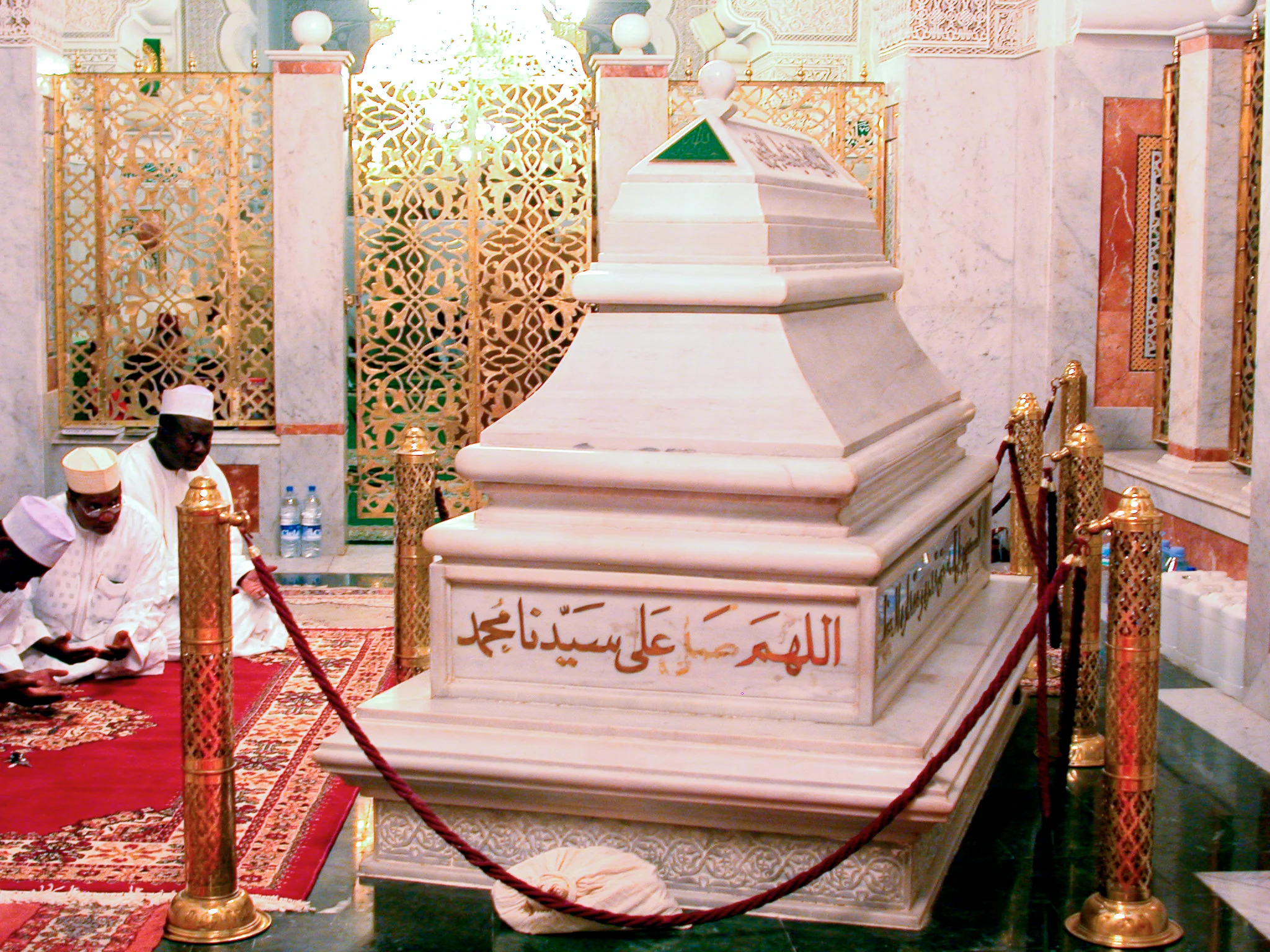
Copyright Catherine Touaibi-Chatagny.
Recitation of the Jawharat al-kamal
View Credits
Recitation of the Jawharat al-kamal by Shamsuddin Margarit. Kutubia Orgiva / Luca Osman Coletti and Micheal Abdul Malik Wheeler.
According to tradition, another special litany, also a prayer to the Prophet Muhammad, was revealed to Ahmad al-Tijani by the Prophet himself and is specific to the tariqa’s liturgy. Called the Jawharat al-kamal (Jewel of Perfection), it is meant to be recited daily at least seven times. Like other Sufi orders, the devotion to the Prophetic figure of Muhammad is fundamental in the Tijani order’s core principles.
O Allah, blessings and peace be upon the source of Divine Mercy
The realized ruby that encompasses the center of understanding and meanings,
The light of all created existants, the Adamic possessor of the Divine Truth
The all-filling light in the rain clouds of gains that fill all the intervening seas and receptacles
Your radiant light with which You have filled Your creation encompassing all possible places,
O Allah, blessings and peace be upon the essence of the Truth from which are manifested the thrones of realities; the source of the most precious knowledge, Your complete and Most Straight Path.
O Allah, blessings and peace be upon the dawning of the Truth by the Truth, the Supreme Treasure, Your Outpouring from Yourself to Yourself; the Encompassment of Talismanic Light.
May Allah bless him and his family, a prayer through which You make him known to us.
Jawharat al-kamal
Translation by Dr. Oludamini Ogunnaike
The Tijaniyya in West Africa
Mainly restricted to the Maghrib during Ahmad al-Tijani’s life, the Tijaniyya expanded southwards into West and sub-Saharan Africa, from Mauritania to Nigeria, in the nineteenth century through scholars. For instance, Mauritanian Shaykh Muhammad al-Hafiz (d. 1830) contributed to the diffusion of the brotherhood after spending time in Fez studying with al-Tijani. However, the greatest expansion of Tijani Sufism occurred with Umar Saitou Tall (ca. 1794–1864), who created the short-lived Tukulor Empire that included parts of present-day Mauritania, Senegal, Mali, and Guinea between 1861 and 1890. Tall contributed to the spreading of Islam and of the Tijaniyya as far as Sudan and Nigeria. The order is particularly important in Senegal where sub-orders emanating from the tariqa have the largest number of followers. The link with Fez and Ahmad al-Tijani is maintained, however, as the ziyara to his tomb is almost as important as performing the hajj for Tijanis.
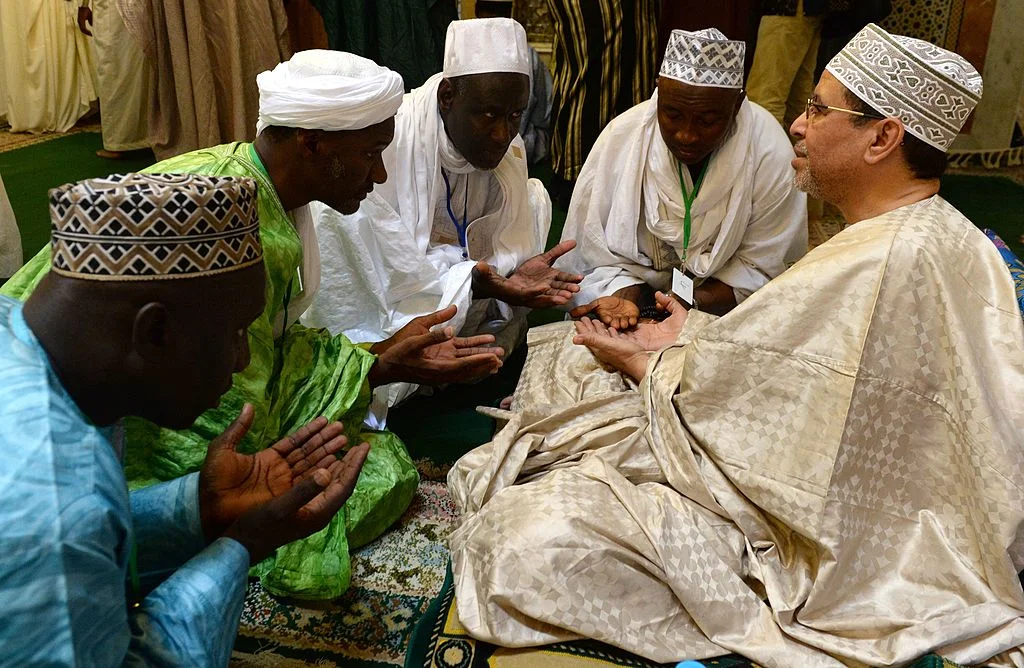
Fadel Senna/AFP via Getty Images.
Throughout West Africa, and particularly in Senegal, Sufi tariqas, like the Tijaniyya, developed urban centers around their leaders, who oscillated between resistance to and conciliation with the French colonial power in the early twentieth century. Sufi shrines built in these cities are places for community gathering, especially on holidays, such as the gamou, the name in Wolof for the mawlid of the Prophet Muhammad.
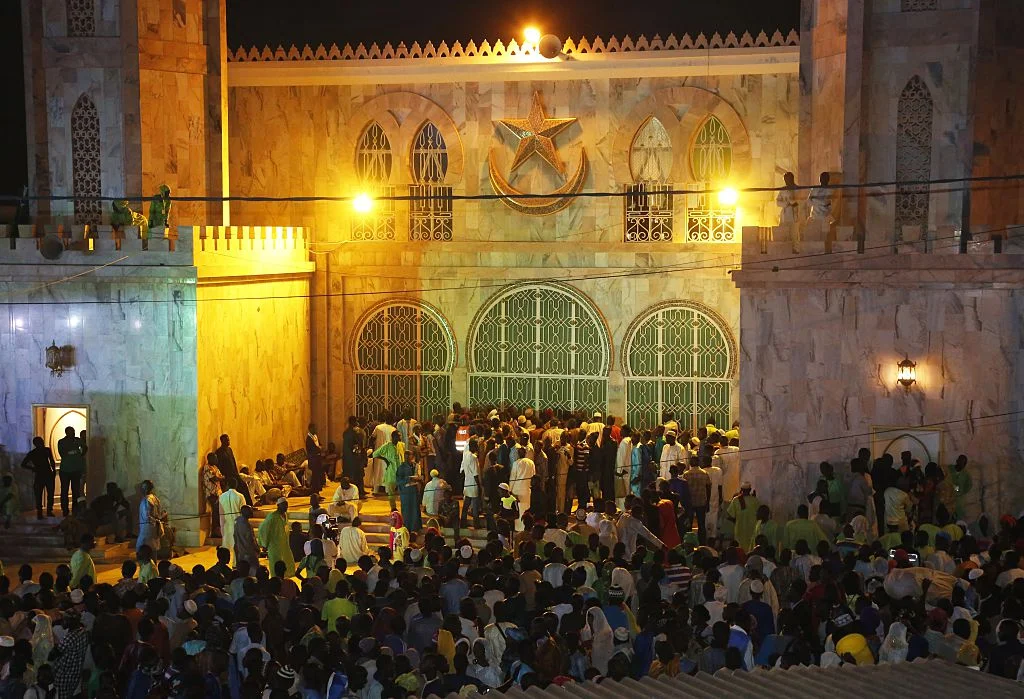
Photo by Cemil Oksuz/Anadolu Agency/Getty Images.
As Eric Ross, professor of geography at Al Akhawayn University in Ifrane, Morocco, mentions: “Senegal’s Sufi shrines are still being built and are continuously being enlarged and embellished. Rather than being windows onto the architectural past, they are evolving in the architectural present, producing a contemporary Islamic architecture with assertive African traits.”
Sufi Cities and Tijani Architecture in Senegal
View Transcript and Credits
Prof. Eric Ross, Professor of Architecture, Al Akhawayn University, Morocco
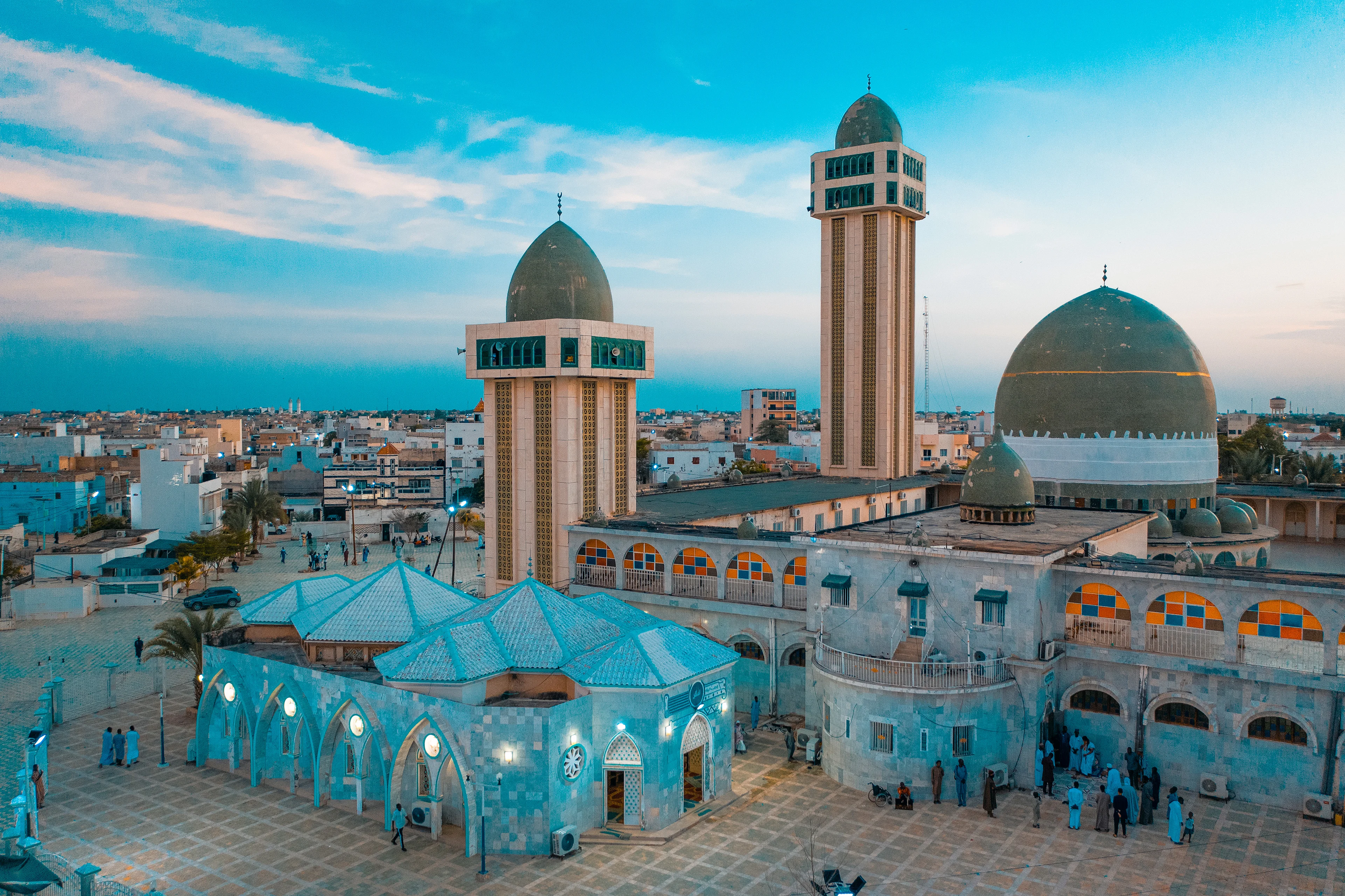
One of the many ways that the Tijaniyya has impacted life in Senegal has been to help configure its built landscape. This is because it has created countless new villages across the country and has built entire new neighborhoods and cities to accommodate disciples and anchor its religious activities. These Sufi towns house the homes of the great shaykhs and major religious institutions. For this region, they are commonly referred to as the “capitals” of the Sufi orders. `The Tijaniyya manages a number of such capitals: Tivaouane, Kaolack, Madina Gounas and Tienaba. Each serves a distinct branch of the order.
Religious devotion in these Sufi cities is lived all hours of the day and night, every day of the week. By day, students attend any number of Islamic schools and institutes while the revered tombs of the shaykhs buried in them receive steady flows of pious visitors.
At night, they resound to the amplified recitations of the many groups of disciples meeting in private homes, mosques or even on residential streets. Furthermore, a variety of religious commemorations are held in them each year, attracting pilgrims from across the country and abroad.
Because Senegal’s Sufi cities are so new, they showcase a unique collection of contemporary Islamic architecture. Sufi monuments elsewhere in the world tend to be centuries-old and they display a great range of Islamic architectural heritage in regional styles.
Senegal’s Sufi shrines, in contrast, are still being built and are continuously being enlarged and embellished. Rather than being windows onto the architectural past, they are evolving in the architectural present, producing a contemporary Islamic architecture with assertive African traits.
Now let’s take a look at Tivaouane, known as the city of three mosques.
The Malikiyya branch of the Tijaniyya was founded by El-Hadj Malick Sy who died in 1922. It is headquartered in Tivaouane’s El-Hadj Malick ward, a neighborhood the order is largely responsible for having built. El-Hadj Malick Sy settled in Tivaouane with some of his followers in 1902.
In 1904 he built a Friday Mosque for the ward and in 1907 he built a zawiyah across the street from his large house. This zawiyah and its single minaret have been rebuilt and expanded several times since el-Hadj Malick Sy was buried there in 1922. Malick Sy was succeeded by his son Ababacar.
When Ababacar died in 1957, he was buried two blocks away from his father’s zawiya, in a new mosque built for him by his sons. This mosque has two minarets. In 1982 Ababacar’s successor, his brother Abdoul Aziz Sy initiated a major reconstruction of this neighborhood.
Several city blocks surrounding the existing religious monuments were expropriated and demolished, and construction got underway on a large new Friday mosque.
This new mosque was inaugurated in September 2024. It was designed in a resolutely modern style. Its prayer hall as an oval shaped plan and has three minarets.
Also this new mosque incorporates on its grounds the small original neighborhood mosque Malick Sy had built in 1904. This is one of the last surviving examples of this early-20th-century urban vernacular mosque style.
Next, let me take you to Kaolack, a Sufi city with global reach. The Fayda branch of the Tijaniyyah, founded by al-hajj Ibrahima Niass (aka Baye Niass. The Fayda branch is headquartered in Kaolack’s Madina Baye ward, a neighborhood Baye Niass established in the 1930s. The Fayda is the most international of Senegal’s Sufi orders.
Ibrahima Niass made numerous trips across Muslim Africa in the 1930s and he personally recruited many disciples from his branch of the Tijaniya in countries such as Ghana and Nigeria both of which were British colonies at the time. Later, in the era of decolonization, Ibrahima Niass became an important public figure. He espoused panafricanism and panislamism and acted as an unofficial diplomat for an independent Senegal. He frequently travelled abroad and met with statesmen of the emerging global south. This too enhanced the global reach of the Faida branch of the Tijaniyya he was leading. In particular One of Niass’s disciples Shaykh Hassan Cisse who had studied in the UK and the US recruited many African-American disciples and opened Zawiyas in major US cities, like Chicago, Detroit, and New York.
Today, Kaolack’s Madina Baye neighborhood is thriving.
Its Great Mosque has been rebuilt and enlarged several times since it was first inaugurated by Baye Niass in 1936. While the exterior of the reinforced concrete Mosque and attendant mausoleum have modern architectural forms, the interiors are decorated in traditional Moroccan motifs evocative of Shaykh Ahmad al-Tijani’s zawiya in Fez.
Beyond this Great Mosque, life in Madina Baye revolves around the needs of its numerous religious schools. The neighborhood attracts students of every level, from pupils learning the Quran to seekers of advanced knowledge in Islamic sciences, and they come from all over, as do some of their professors. In Kaolack, One can hear conversations switching from wolof to classical Arabic to Hausa or American English.
The Great Mosque of Medina Baye at Kaolack, Senegal. Abdoulaye Sarr Mbaye/iStock/Getty Images.
Map of Senegal with Tijani shrines. Courtesy of Eric Ross.
Writing wooden boards with Qur’anic inscriptions used by students at the zawiya of El-Hadj Malick Sy in Tivaouane. Photograph by Charles O. Cecil / Alamy Stock Photo
Night celebrations of the gamou or mawlid of the Prophet Muhammad at the Ababacar Sy Mosque in Tivaouane, Senegal. Photograph by Cemil Oksuz / Anadolu Agency/Getty Images.
Zawiya of El-Hadj Malick Sy, Tivaouane. Courtesy of Eric Ross.
Unidentified photographer, portrait of el-Hadj Malick Sy, probably ca. 1910s, from Paul Marty, Études sur l’Islam au Sénégal, Paris: E. Leroux, 1917, volume I, page 177. Courtesy of Bibliothèque nationale de France, Paris.
Zawiya of El-Hadj Malick Sy, Tivaouane. Courtesy of Eric Ross.
Ababacar Sy Mosque, Tivaouane. Courtesy of Eric Ross.
Map of Tivaouane in 1974. Courtesy of Eric Ross.
Map of Tivaouane in 2025. Courtesy of Eric Ross.
Great Mosque El-Hadj Malick Sy, Tivaouane. Cellule Zawiya Tijaniyya.
Interior of the main hall of the Great Mosque El-Hadj Malick Sy, Tivaouane. Cellule Zawiya Tijaniyya.
The original mosque built by el-Hadj Malick Sy in 1904, Tivaouane. Courtesy of Eric Ross.
The Great Mosque of Medina Baye at Kaolack, Senegal. Abdoulaye Sarr Mbaye/iStock/Getty Images.
Book cover of A Defense and Clarification of the Tariqa Tijaniyya and the Tijanis by Shaykh Ibrahim Niasse. Fayda Books, LLC.
The Great Mosque of Medina Baye at Kaolack, Senegal. Abdoulaye Sarr Mbaye/iStock/Getty Images.
The Great Mosque of Medina Baye with the mausoleum of Shaykh Ibrahim Niasse at Kaolack, Senegal. Rashad “RJ” Mahdi / I AM MEDINA BAYE Project
Inside the Great Mosque of Medina Baye at Kaolack, Senegal. Rashad “RJ” Mahdi / I AM MEDINA BAYE Project
© RMN-Grand Palais / Art Resource, NY.
Sufi Popular Arts
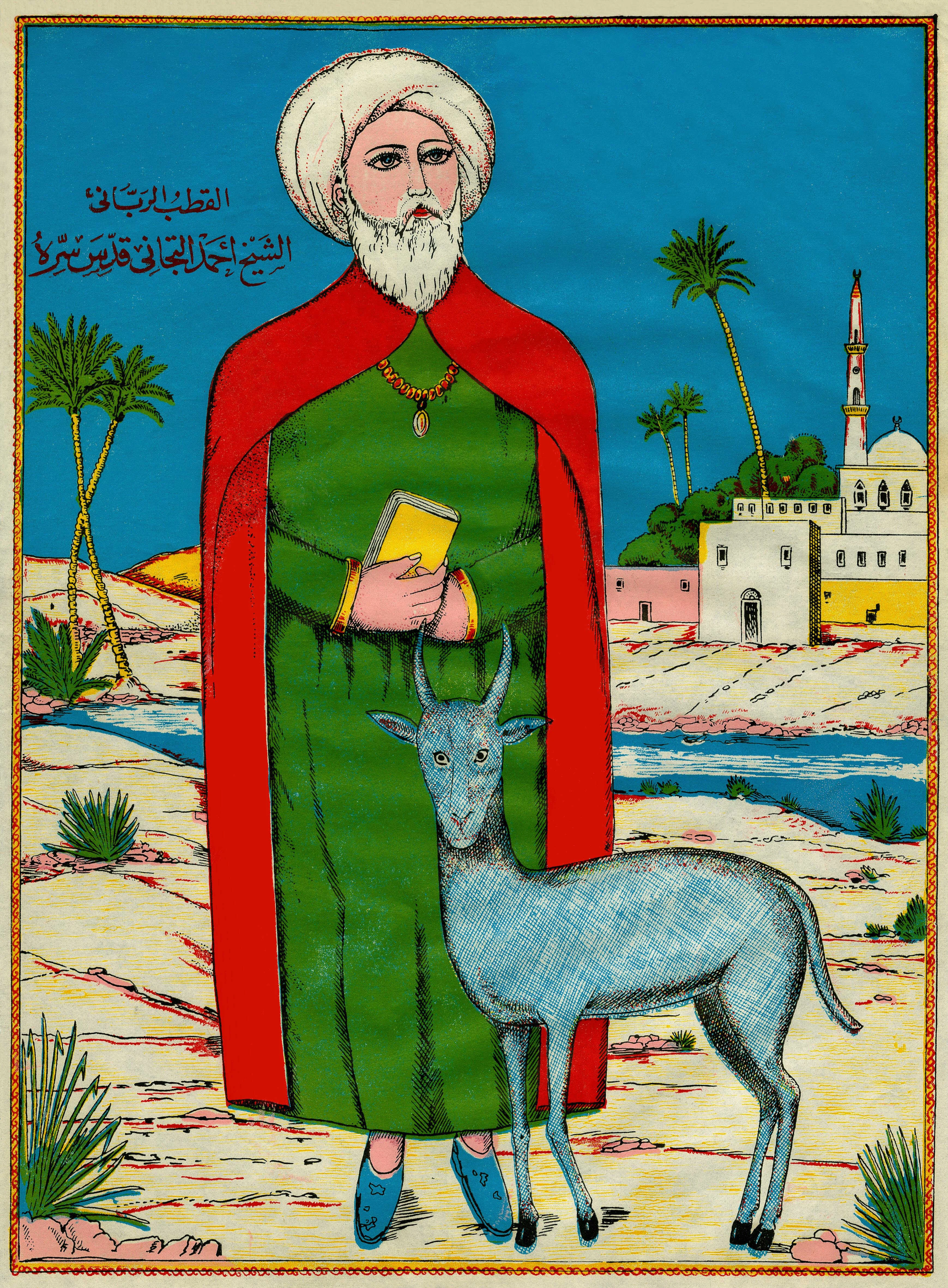
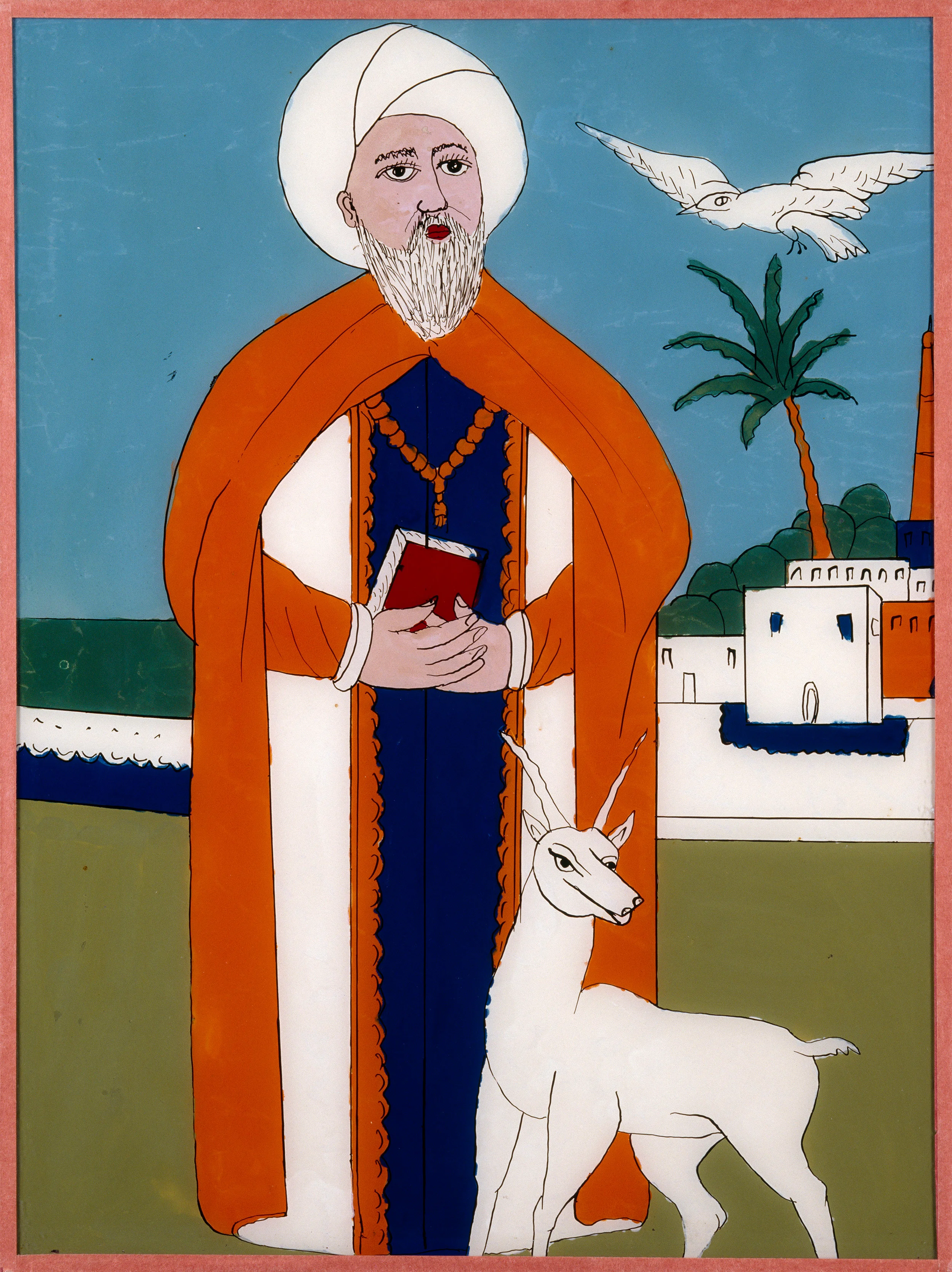
The introduction of portraits of Muslim figures into Senegal in the early twentieth century was integral to the development of Sufi brotherhoods. Representations of Sufi leaders gained popularity and served as devotional images with the ability to transmit baraka. A particularly popular genre is glass painting, like this anonymous work from the mid-twentieth century depicting Ahmad al-Tijani. The diffusion of such images increased after World War I, and they eventually supplanted other pan-Islamic images, like depictions of Buraq, the fantastic mount onto which Muhammad performed his mi‘raj (night journey to heaven).
A Tijani Glass Painting from Senegal
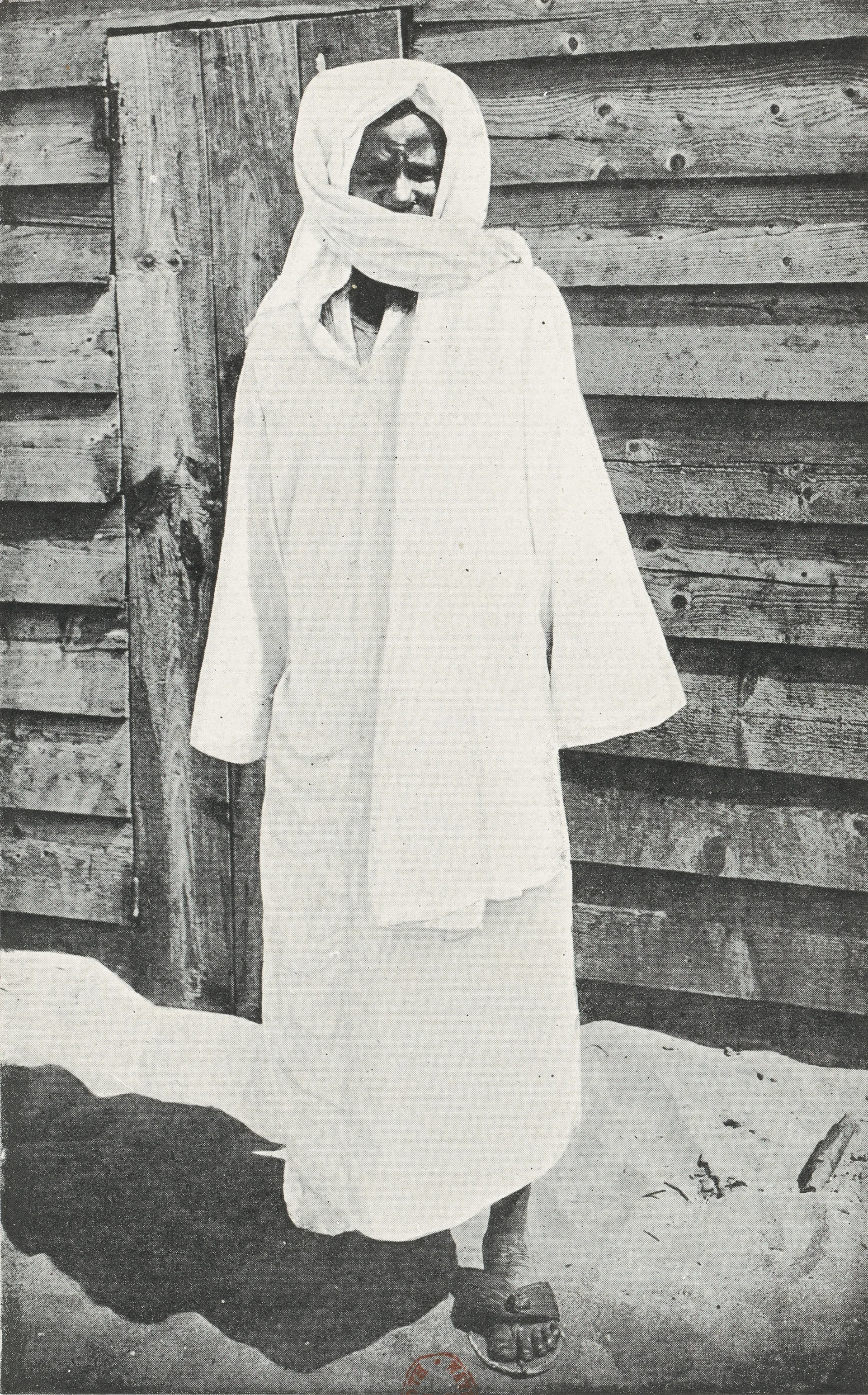
Courtesy of Bibliothèque nationale de France, Paris.
Portraits of saints and Sufi leaders are ubiquitous. They are part of a particular Islamic visual culture that developed in West Africa. Such devotional images can be found on small, portative objects such as amulets, as well as on walls and motorized vehicles, especially taxis and minibuses.
Alongside the Tijanis, the Murid tariqa is one of the most popular brotherhoods in Senegal and embodied by the figure of its founder, Shaykh Amadou Bamba. A single photograph of him exists, taken in 1913, which has served as the sole source for the saint’s representations.
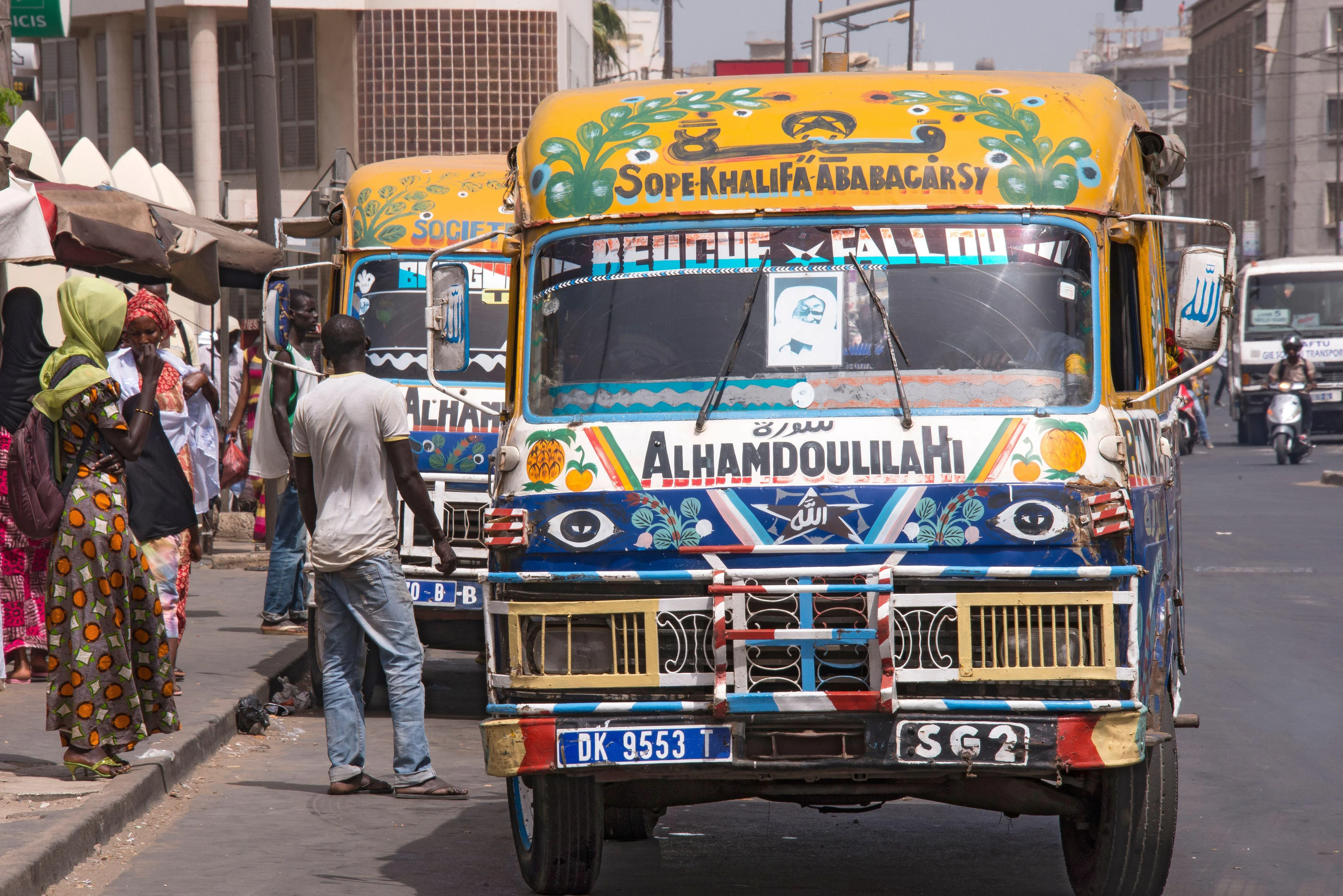
Photo by Salvador Aznar/Alamy Stock Photo.
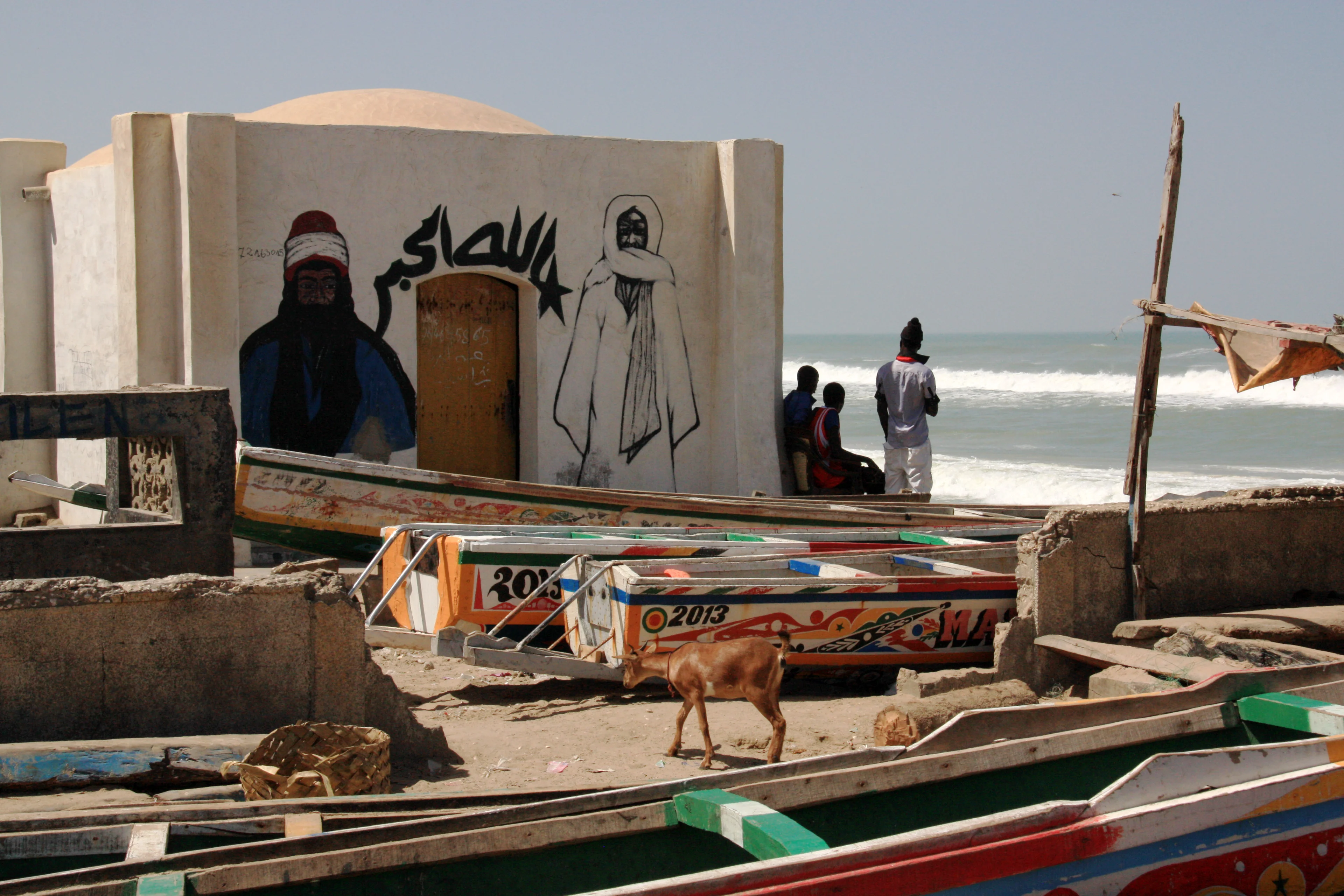
aroundtheworld.photography/ iStock Editorial / Getty Images Plus.
To complement the omnipresence of Sufi images in Senegalese public spaces is the sound of Sufi music. Extremely dynamic and popular, songs mix Sufi poetry in Arabic and praise poetry in the local Wolof language with modern rhythms and tempos, such as hip-hop and reggae. They also proliferate in video clips. Here, the famous hip-hop band Bideew Bou Bess interprets a song calling to the memory of highly revered Shaykh Ibrahim Niasse (1900–1975), who is at the inception of the largest Tijani sub-branch in Senegal, centered in Medina Baye in the city of Kaolack. His followers and disciples affectionally refer to him as Baye (“father,” in Wolof). Textual and visual allusions to piety, Islamic faith, Sufi practices like dhikr, and reverence to Niasse come together in praise of both God’s immanence and the shaykh’s transcendence.
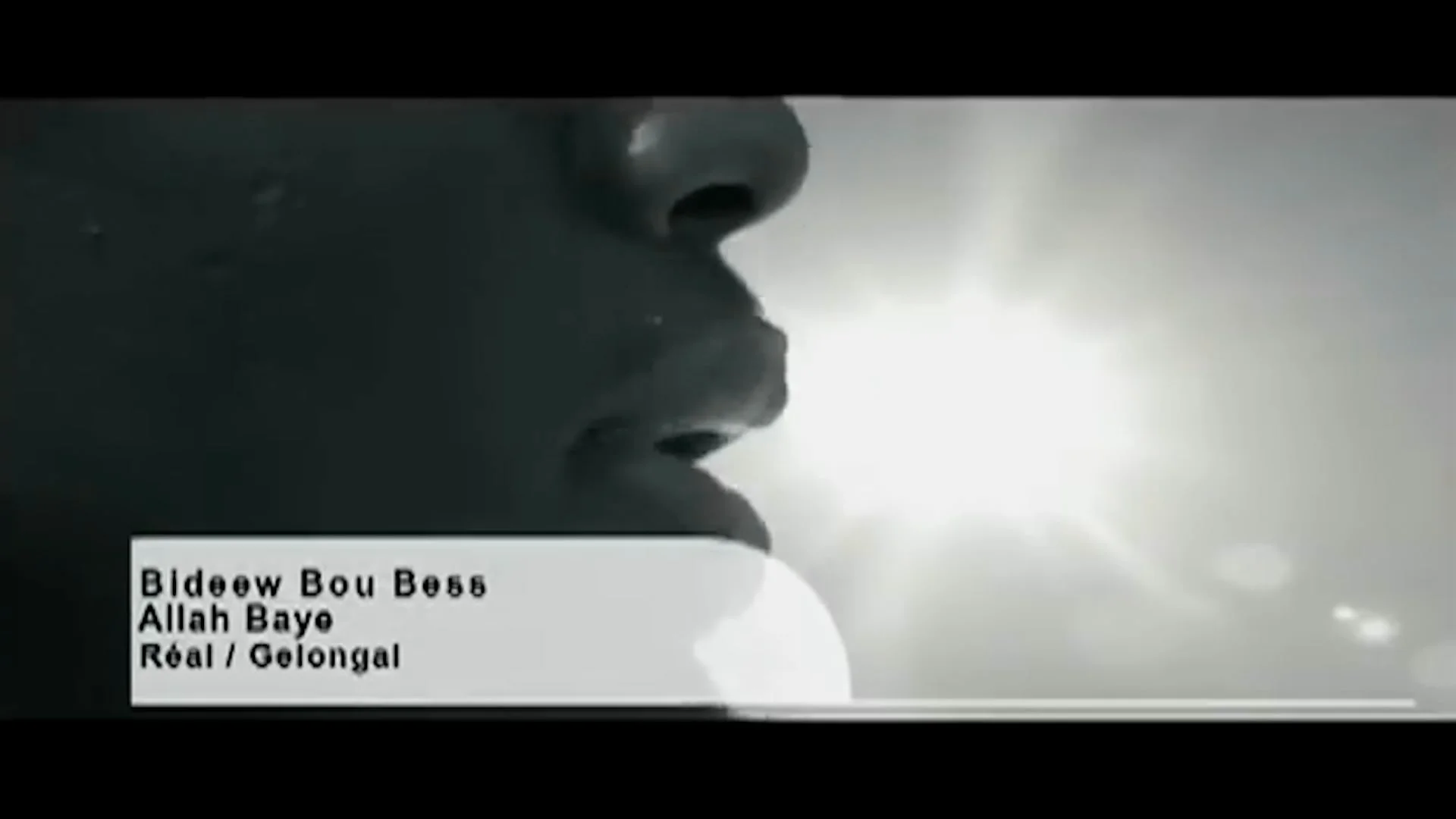 Close-up of a person's face in profile with sunlight in the background; text overlay reads "Bideew Bou Bess, Allah Baye, Réal / Geolongal."
View Credits
Bideew Bou Bess, Allah Baye, 2012.
Allah Baye – vidéo clip officiel, Bideew Bou Bess (Prod. 3BE Sarl, Senegal, 2017).
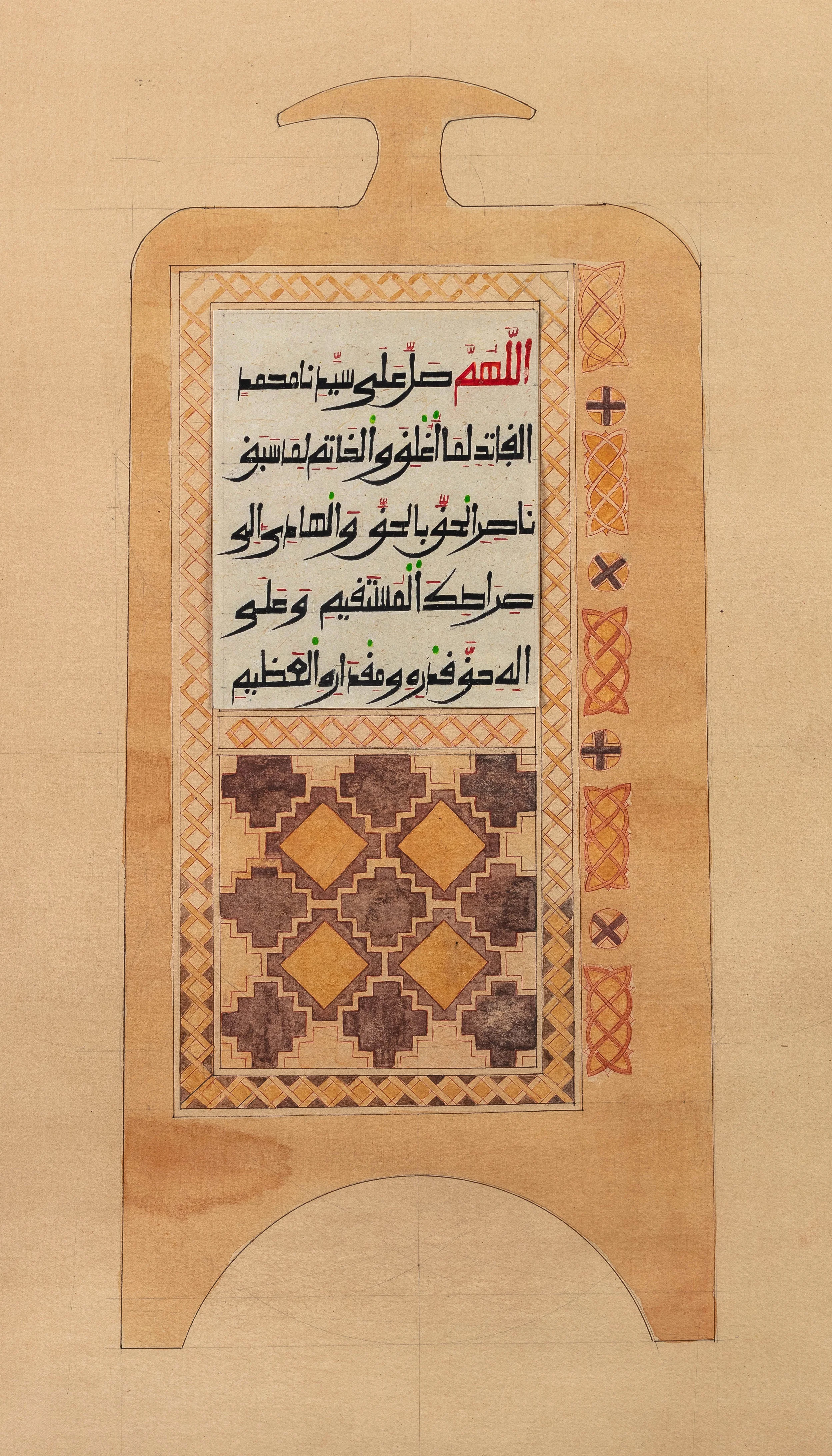
© Halima Lami Bashir.
Sufi Contemporary Art
Like many other Sufi orders, the Tijaniyya has expanded worldwide. On a global scale, devotion to Ahmad al-Tijani and the Tijani shaykhs inspires artists affiliated with the tariqa, such as Halima Lami Bashir and Rachid Koraïchi.
Calligrapher Halima Lami Bashir is from Nigeria and a member of the Tijani order. She depicted an allo (from the Arabic al-lawh, or “tablet”), a traditional wooden board, which students in West Africa use to inscribe with excerpts from the Qur’an and learn them by heart. In this example, Bashir wrote the Salat al-fatih, a wird specific to the Tijanis that they recite every day instead of reproducing a Qur’anic verse. It is written in a regional script, called Sudani, used exclusively in West Africa for copying the Qur’an and prayers in Arabic. Bashir’s work exemplifies how today’s religious practices and artistic traditions intertwine and how the dynamism of the Sufi tradition integrates local and regional styles that can reach global audiences.
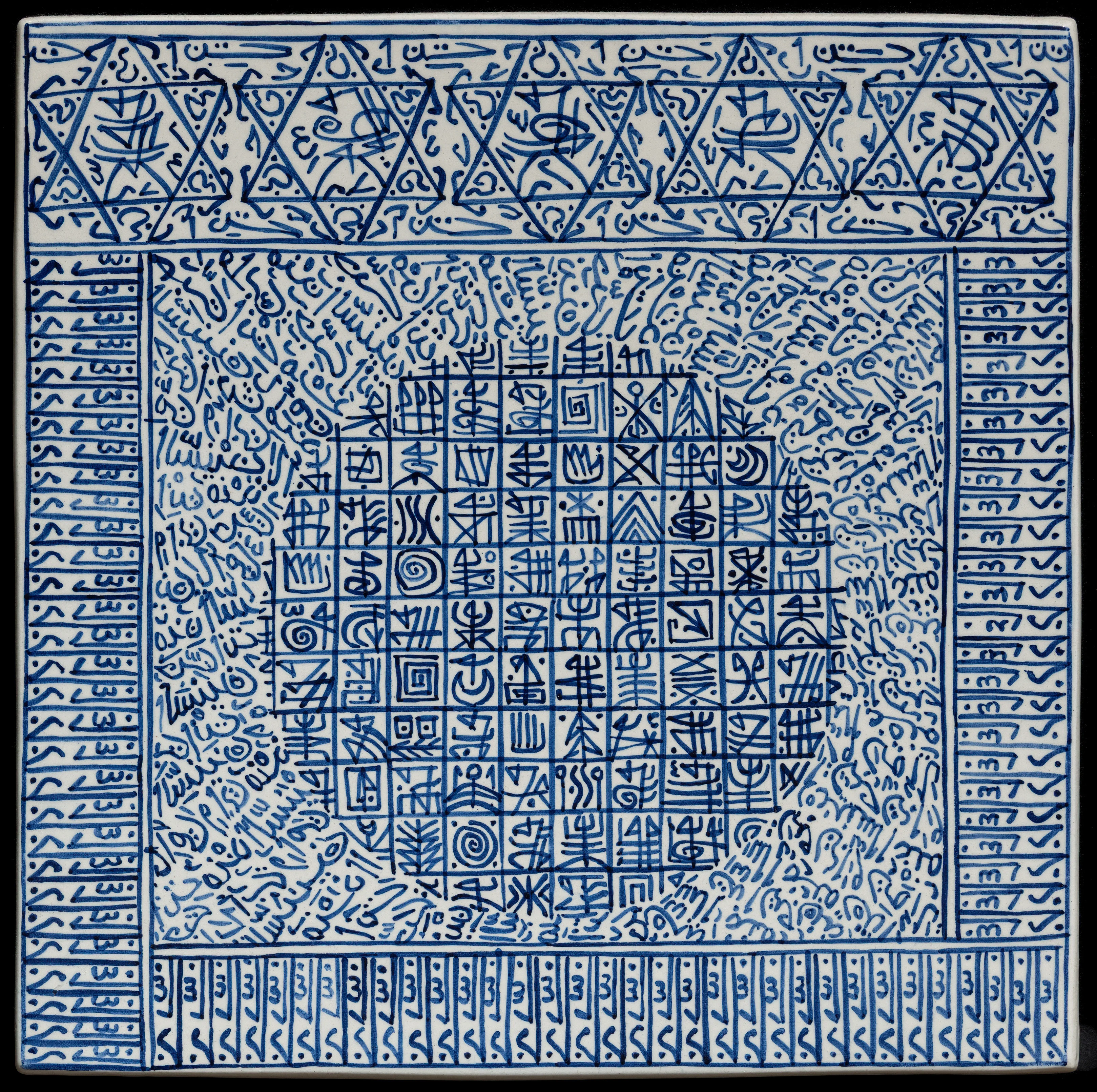
Rachid Koraïchi, © 2025 ADAGP, Paris / ARS, New York. Photograph: © 2025 Museum of Fine Arts, Boston.
Rachid Koraïchi’s family originated in Aïn Madhi, Ahmad al-Tijani’s birthplace, and has been part of the tariqa for generations. Deeply influenced by the teachings of al-Tijani and other major Sufi figures, Koraïchi has been creating works in which Sufism and mystical knowledge serve as a source of inspiration. For instance, with repetition of words and symbols, Les maîtres du temps (The Masters of Time) and Les osties bleues (The Blue Wafers) emphasize the practice of dhikr, which draws devotees closer to God. Adhering to Sufi principles, Koraïchi continues to be inspired by his own experience and the study of great philosophers and mystics.
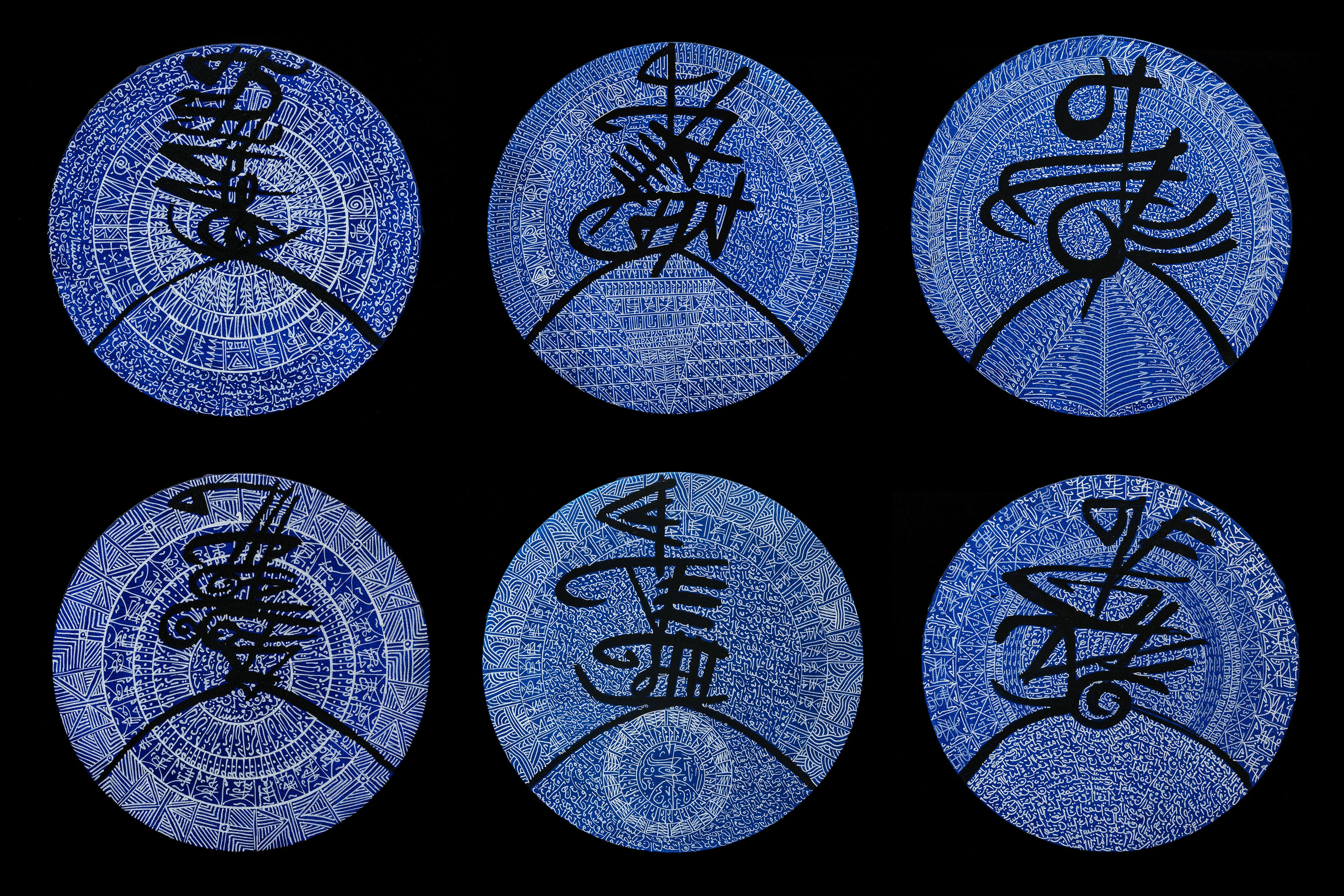 Six blue circular abstract artworks with intricate white line patterns and bold black calligraphic symbols, arranged in two rows of three against a black background.
View Credits
Rachid Koraïchi (Franco-Algerian), Les Osties Bleues, 2018, acrylic on canvas. Boston, Museum of Fine Arts, Gift of Nicholas Chubrich in memory of Mary Mills, 2023.1088 to 2023.1093.
Rumi and Ibn Arabi thought deeply about building an infinite love of everyone for everyone. . . Those Sufi masters are no longer here with us, but their spirit lives on between us
Rachid Koraïchi
Locations
Explore the map or scroll to select a location.